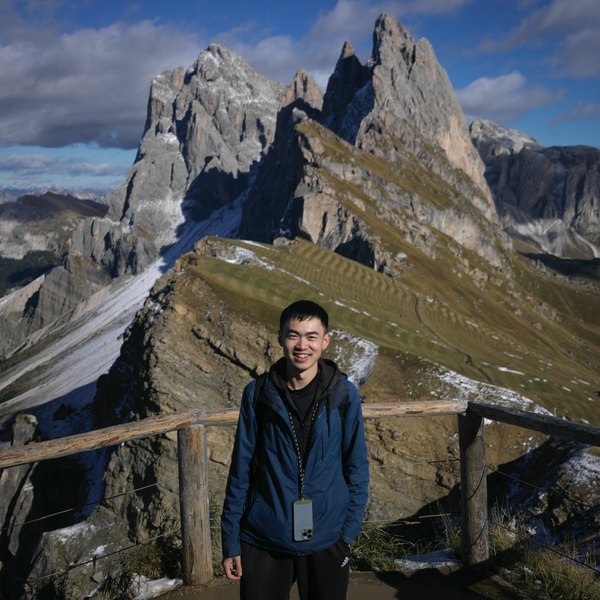
Frank Yingjie Huo
I study exactly solvable many-body dynamics, from complex networks to Transformer AI.
Email · Google Scholar · CV
I am a PhD candidate in Theoretical Physics at George Washington University, where I hold a Columbian Distinguished Fellowship, and expect to complete my PhD in May 2027. I am fortunate to be advised by Prof. Neil F. Johnson. Before my PhD, I studied at Pembroke College, University of Cambridge, where I received a BA in Physics (Natural Sciences Tripos) and an MMath (Part III of the Mathematical Tripos).
I develop exactly solvable models of collective dynamics in complex systems. I currently focus on the dynamics of Transformer-based AI, from the microscopic scale of a single attention head to the coarse-grained level of a whole conversation. In recent work, together with Prof. Johnson, we show from first principles that the attention mechanism sets up a competition between tokens during text generation, analogous to two-body interactions in a multispin system, which leads to token repetition and tipping between outputs (AIP Advances, 2026); trace how this competition propagates through the layers of a Transformer (arXiv, 2026); and test a simple tipping criterion against observations of real models (Patterns, 2026). This work has received press coverage, including in The Independent, El País, Live Science, and Nautilus.
Earlier in my PhD, I developed theories of heterogeneous assembly and fragmentation dynamics on complex networks, and applied them to real-world systems, online and offline (PRL 2023, 2024). These theories are set out in full, with substantial new results, in our book Introduction to Online Complexity (Oxford University Press, 2025), of which I am lead author. A full list of my work is on the Publications page.
Teaching is one of the most rewarding parts of my work. In 2022 I received the Bennhold Family Award for best graduate-student teaching at George Washington University, where I have taught physics as a teaching assistant since 2021. More on my teaching.
Outside research, I enjoy history and culture. I play the piano, go to concerts and operas, and I constantly look for a kind of universality in our civilization through history: the correspondences between developments in art, music, science, and more.